
 Facebook
 X
X
 Pinterest
 Copy Link

Rao Market Intelligence Series: Should You Sell Your Cupertino Home in 2026 or Wait? A Data-Driven Decision Guide
“The decision to sell your home isn’t about timing the market perfectly. It’s about understanding today’s opportunities, tomorrow’s possibilities, and your own financial goals.”
Executive Summary
Many Cupertino homeowners are asking the same question:
“Should I sell my home now, or wait another year?”
There isn’t a universal answer.
The Cupertino housing market remains fundamentally healthy. Well-prepared homes continue to attract strong buyer interest, while overpriced or poorly presented homes often remain on the market longer. At the same time, several macroeconomic trends—including improving equity markets, continued investment in artificial intelligence, and the possibility of future liquidity events among technology companies—could create even stronger buyer demand over the next 12 to 24 months.
That doesn’t mean every homeowner should wait. Nor does it mean every homeowner should sell today.
The right decision depends on balancing current market conditions with your personal financial objectives, lifestyle needs, and tolerance for uncertainty.
In this article, I’ll examine both sides of the decision, review the latest Cupertino market data, discuss the factors that may influence housing demand over the next several years, and share how I advise clients facing this important choice.
Key Takeaways
-
Cupertino remains one of the strongest residential real estate markets in Silicon Valley because of its schools, limited housing supply, and proximity to major technology employers.
-
Today’s buyers remain active, but they are more selective and better informed than in previous years.
-
Well-prepared, strategically priced homes continue to outperform the broader market.
-
A strong stock market, AI-driven economic growth, and future technology liquidity events could increase housing demand over the next few years—but these outcomes are not guaranteed.
-
Waiting may benefit some homeowners, while others may achieve better overall financial results by selling today and moving forward with their life plans.
-
The best decision is usually based on personal circumstances, not attempts to predict short-term market movements.
Cupertino Market Snapshot – First Half of 2026
Homes Listed. 186
Homes Sold. 95
Estimated Months of Inventory. approx. 2 months
Median Sale Price. $3,400,000
Average Days on Market: 13 Days
Average Sale-to-List Price Ratio 107.7%
What These Numbers Tell Us
At first glance, these statistics paint the picture of a market that remains remarkably healthy.
Although buyers have become more selective than they were during the peak pandemic years, demand for desirable Cupertino homes remains strong. Nearly all successfully marketed homes sold in less than two weeks on average, and sellers continued to receive offers above asking price, with the average home selling for 107.7% of its list price.
Inventory also remained relatively tight at approximately two months of supply, well below the four to six months generally associated with a balanced market. Limited inventory continues to provide meaningful support for home values, particularly in Cupertino’s most sought-after neighborhoods and school attendance areas.
At the same time, these headline numbers do not tell the entire story.
The market is becoming increasingly selective. Homes that are thoughtfully prepared, professionally marketed, and priced in line with current buyer expectations continue to perform exceptionally well. In contrast, homes that enter the market overpriced or in need of significant updating often experience longer marketing times and price adjustments before attracting serious buyers.
This evolving dynamic is one of the reasons homeowners are asking an important question:
Should I capitalize on today’s strong market, or could waiting another year produce even better results?
That question deserves a thoughtful, balanced analysis—and the remainder of this report explores both sides of that decision.
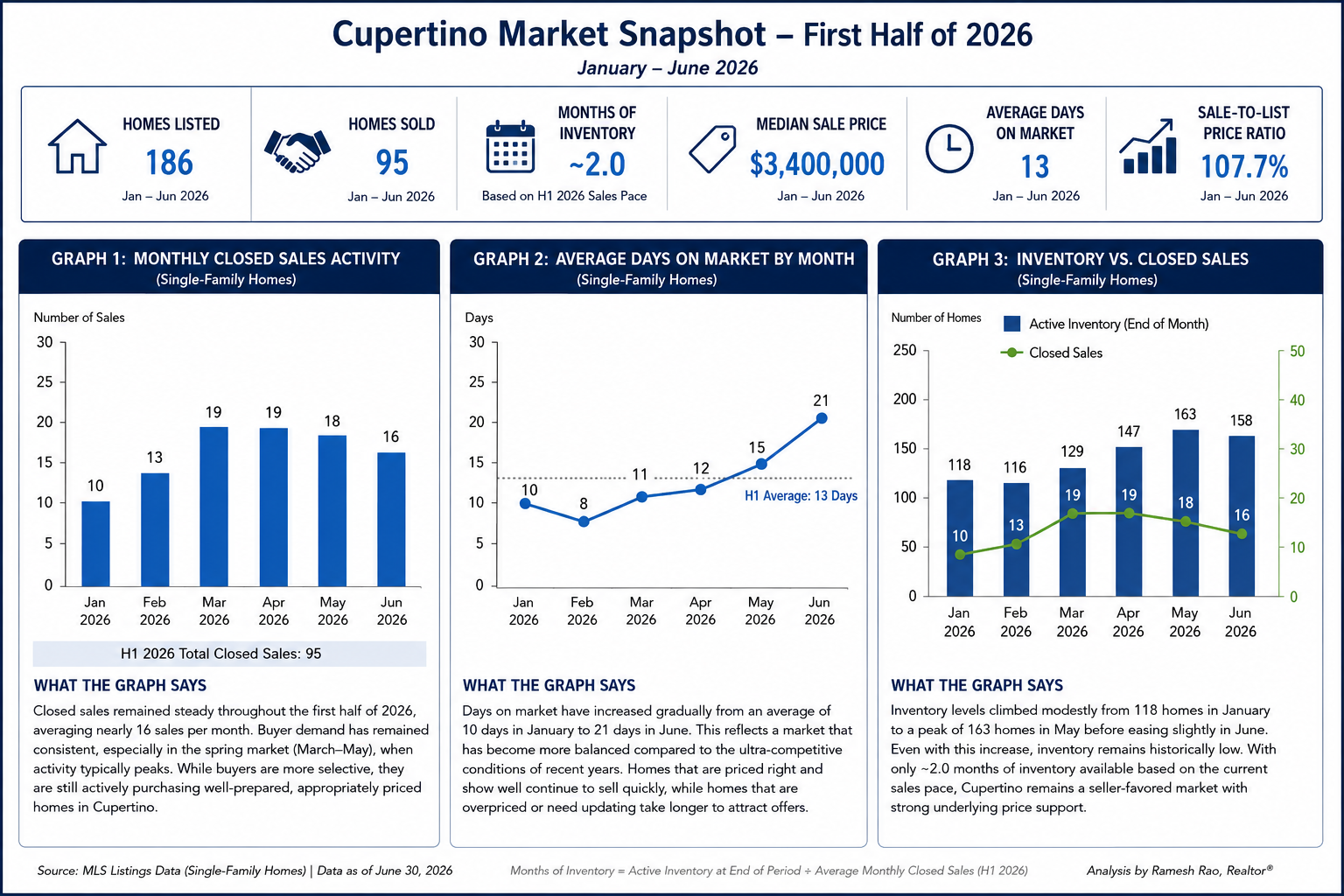
Graph 1 – Closed Sales Activity
What the Graph Says
Although buyers have become more selective, they have not disappeared.
Transaction volume continues to indicate that qualified purchasers are actively competing for desirable homes, particularly those in highly sought-after school attendance areas such as Monta Vista High, Lynbrook High, and Cupertino High.
The key difference compared with previous years is that buyers now expect homes to justify their asking prices through condition, presentation, and realistic pricing.
Graph 2 – Average Days on Market
What the Graph Says
The average marketing time has increased modestly compared with the frenzied conditions experienced during the pandemic years.
This should not be interpreted as a weak market.
Instead, it reflects a transition toward a healthier, more balanced environment where buyers have slightly more time to evaluate their options.
Properties that are well prepared continue to sell quickly, while homes requiring significant updates or carrying unrealistic price expectations often experience longer marketing periods.
Graph 3 – Inventory vs. Closed Sales
What the Graph Says
Inventory remains historically limited compared with many other Bay Area communities.
Limited supply continues to support home values, even during periods of economic uncertainty.
This imbalance between available inventory and long-term demand remains one of Cupertino’s greatest strengths.
Why Some Homeowners May Benefit From Selling Now
For many families, selling today may be the most prudent decision.
Current homeowners continue to benefit from:
-
historically significant equity gains
-
sustained buyer demand for desirable homes
-
limited competing inventory
-
strong pricing for well-prepared properties
If your plans include relocating, downsizing, purchasing another property, or diversifying your investments, today’s market offers a favorable environment to achieve those goals.
Waiting for higher prices while postponing important life decisions is not always the most beneficial strategy.
Sometimes certainty has greater value than speculation.
Why Waiting Could Be Rewarded
This is where the discussion becomes more nuanced.
Although no one can predict the future with certainty, several long-term trends could strengthen demand for Silicon Valley housing over the coming years.
Artificial Intelligence May Create Another Wealth Cycle
Silicon Valley has repeatedly experienced periods of rapid wealth creation following transformative technology shifts.
The personal computer era, the internet revolution, cloud computing, smartphones, and social media each generated substantial wealth for employees, founders, and investors. Much of that wealth eventually found its way into residential real estate.
Artificial intelligence has the potential to become another such cycle.
Several prominent AI companies remain privately held. If some ultimately pursue public offerings or other liquidity events, many employees could gain significant purchasing power, increasing demand for homes throughout Silicon Valley.
While the timing and scale of any future liquidity events remain uncertain, the possibility deserves consideration as part of a long-term outlook.
A Stronger Stock Market Can Support Housing Demand
Many Cupertino buyers rely on more than salary alone. Restricted stock units (RSUs), stock options, annual bonuses, and vested equity often provide a substantial portion of their down payment.
When technology stocks perform well, household balance sheets strengthen, and buyer confidence often improves. A healthy equity market can therefore contribute to stronger housing demand, particularly in communities with a high concentration of technology professionals.
Interest Rates Could Improve Affordability
If mortgage interest rates gradually decline over the next 12 to 24 months, monthly payments could become more manageable for many buyers.
Improved affordability may bring additional purchasers back into the market, increasing competition for available homes.
Reasons Waiting May Not Produce Better Results
Waiting also involves risk.
No one knows:
-
whether interest rates will decline or remain elevated
-
When or if major technology companies will pursue liquidity events
-
Whether additional inventory will come to market
-
How economic policy may evolve
-
How global events could affect financial markets
Markets rarely move in straight lines.
Trying to predict the exact peak often results in missed opportunities.
When Waiting Makes Sense
Waiting may be an appropriate strategy if:
-
You have no immediate need to move.
-
Your financial situation is secure.
-
You believe your property will continue to appreciate over time.
-
You are comfortable accepting market uncertainty.
-
You anticipate benefiting from a future technology-driven increase in buyer demand.
-
Your home meets the family’s needs for several more years.
When Selling Now Makes Sense
Selling today may be the better decision if:
-
You are relocating for work or retirement.
-
You have already achieved substantial appreciation.
-
You wish to simplify your lifestyle.
-
You intend to diversify your investments.
-
Your home is well positioned to compete in today’s market.
-
The timing aligns with your family’s personal goals.
Market Wisdom
The best time to sell is not necessarily when prices are highest. It is when your personal goals and market conditions align.
Many homeowners spend years trying to identify the perfect market peak.
In reality, preparing your home thoughtfully and executing a strategic marketing plan often has a greater impact on your final sales price than predicting the next market cycle.
My Perspective
One of the reasons I enjoy advising homeowners is that every decision is unique.
Some clients are ready to begin a new chapter of life. Others are building generational wealth and can afford to think decades ahead.
Cupertino has rewarded long-term homeowners exceptionally well over many years. I remain optimistic about its future because of its outstanding schools, limited land supply, and proximity to the world’s leading technology companies.
At the same time, I don’t believe homeowners should delay important life decisions solely in hopes of capturing the next wave of appreciation. Future demand could certainly strengthen if artificial intelligence drives another period of wealth creation and if equity markets continue to perform well. However, those possibilities are not guarantees, and successful financial planning requires balancing optimism with realism.
When I meet with clients, my goal is not to persuade them to sell. My role is to provide objective market intelligence, explain the opportunities and risks, and help them choose the path that best supports their long-term financial and personal objectives.
Sometimes that recommendation is to list the home now. Other times, it is to wait.
Either decision can be the right one when it is made thoughtfully and with a clear understanding of both today’s market and tomorrow’s possibilities.
Final Thoughts
There is no universal answer to whether you should sell your Cupertino home in 2026 or wait.
For some homeowners, today’s market offers an excellent opportunity to capitalize on strong pricing and limited inventory while advancing their personal goals.
For others, particularly those with flexibility and a long investment horizon, waiting may allow them to benefit if another technology-driven wealth cycle, improved stock market performance, or lower interest rates translate into stronger housing demand.
Rather than asking, “Will prices be higher next year?” consider a more useful question:
“Which decision best supports my family’s financial future?”
That’s the conversation I enjoy having with homeowners—one grounded in data, experience, and your individual goals, not speculation.
Frequently Asked Questions
Is 2026 a good time to sell a home in Cupertino?
For many homeowners, yes. Well-prepared homes continue to attract strong buyer interest, although the best decision depends on your personal objectives.
Could Cupertino home prices rise further?
They could. Continued growth in the technology sector, strong equity markets, and future AI-related liquidity events may support demand. However, future market performance is never guaranteed.
Should I renovate before selling?
Not always. Strategic improvements—such as painting, landscaping, staging, and addressing deferred maintenance—often provide a better return than extensive remodeling. Every property should be evaluated individually.
How do I know whether waiting is the right choice?
Review your financial goals, housing needs, tax considerations, and market conditions together. A personalized analysis is far more valuable than relying on headlines or generalized market predictions.
Call to Action
If you’re weighing whether to sell now or wait, I’d be happy to help you evaluate the decision with data rather than assumptions.
Together, we can review:
-
Your home’s current market value
-
Recent comparable sales in your neighborhood
-
Current buyer demand in your price range
-
The likely impact of preparing your home for sale
-
Whether selling now or waiting better aligns with your financial and lifestyle goals
There is no one-size-fits-all answer. My goal is to provide you with the market intelligence you need to make a confident, well-informed decision, whether that means listing your home this year or deciding that waiting is the better course for you.
About the Author
Ramesh Rao is a Silicon Valley Realtor® with Coldwell Banker Realty specializing in Cupertino and the surrounding luxury communities. With more than 30 years of experience, he helps buyers and sellers make confident real estate decisions through data-driven market analysis, strategic marketing, and expert negotiation. Through his Rao Market Intelligence™ series, Ramesh shares local market insights to help homeowners navigate an ever-changing real estate market.
Ramesh can be reached at www.RameshSellsHomes.com or call (408) 806-6496.

