
 Facebook
 X
X
 Pinterest
 Copy Link
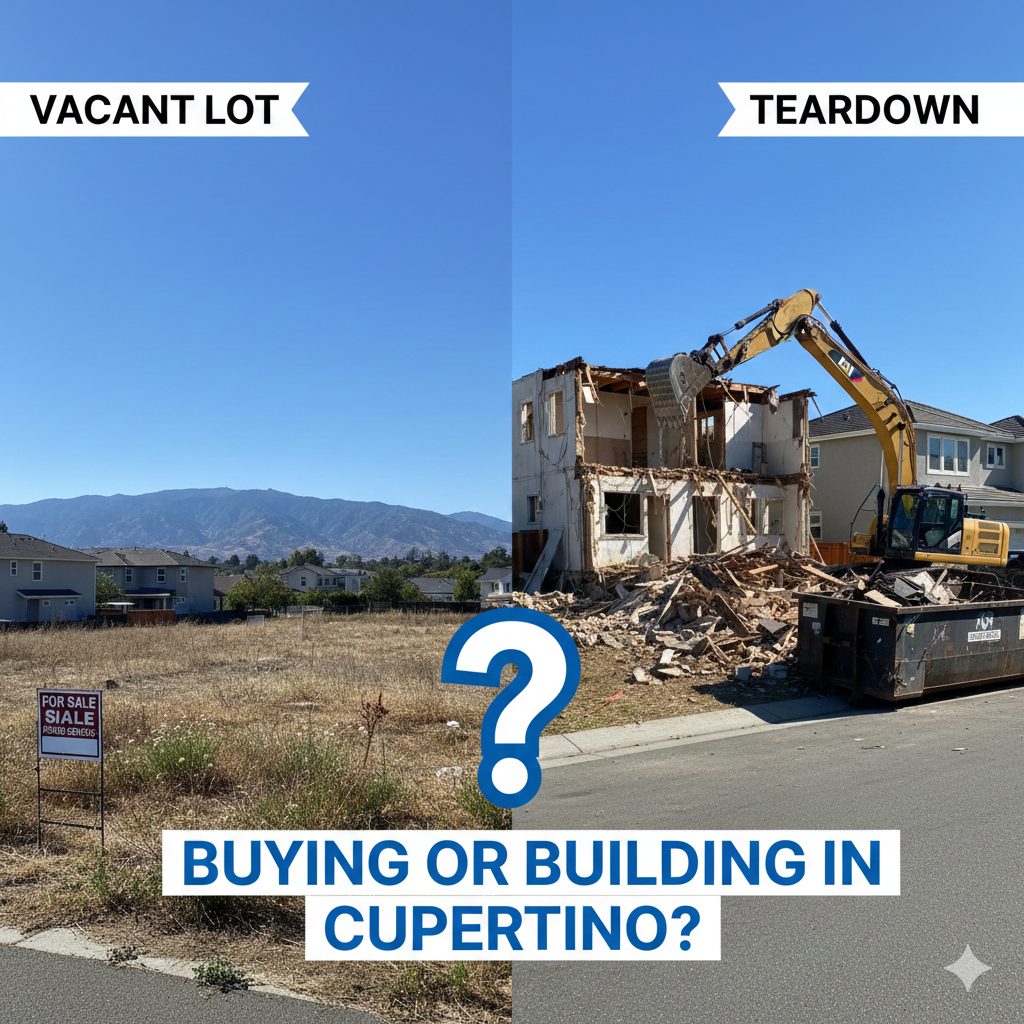
Buying or Building in Cupertino: Vacant Lot vs. Teardown
In flat Cupertino neighborhoods with top schools, most buyers who want a brand‑new home are really choosing how to get there—not whether they will build at all. With construction running about $1000 per square foot, a 3,500 sf new home implies roughly $3.5M in build cost alone, so the real question is whether you chase a rare vacant lot or buy a teardown and rebuild.
The vacant lot dream
For many buyers, the idea of finding an empty lot and designing a home from scratch is the purest version of the dream. You start with a clean slate, no legacy walls, no awkward additions, and no need to “work around” someone else’s choices.
-
High design control: You and your architect can optimize everything, orientation, natural light, structural systems, energy performance, and layout, without constraints from an existing structure.
-
Cleaner construction: No demolition phase and fewer surprises hiding in old foundations or unpermitted work, which can reduce change orders and stress during the build.
The catch is inventory. In flat Cupertino, with top schools and easy access to Apple and major corridors, true vacant lots are extremely scarce; most “land” opportunities have already been built on or sit in more challenging hillside locations. For a typical buyer, waiting for the perfect flat vacant lot can mean putting life on hold with no clear timeline.
The teardown reality
Most of the new 3,000–4,000 sf homes you see in Cupertino’s core neighborhoods started life as modest 1960s–1970s ranches that were scraped or substantially rebuilt. That older home is really a land vehicle: you buy the lot, then replace the structure with something that reflects today’s lifestyle and standards.
-
Better inventory and locations: Older homes on 6,000–8,000 sf lots are the standard “input” in these areas, already inside the right school boundaries, with sidewalks, utilities, and commute routes dialed in.
-
More predictable approvals: Because the lot already supports a single‑family residence with established utilities and access, planning and permitting tend to follow a more familiar path than with unusual or marginal vacant parcels.
The trade‑offs are real. You add demolition, potential asbestos or lead abatement, and an interim period where you are carrying a property you cannot fully use while you wait for plans and permits. You also face competition: the same teardowns attract builders, investors, and other end‑users who see the same potential.
Cost: why the path matters more than the math
At an assumed $1000 per square foot, a 3,500 sf build puts construction around $3.5M, whether you start from a vacant lot or a teardown. On top of that, you layer:
-
Land cost: What you pay for the lot or the teardown structure (which is essentially land value).
-
Soft costs: Architecture, engineering, city fees, utilities, surveys, and financing costs.
-
Time cost: Months of holding the property before move‑in, including rent or alternate housing.
Because the core build cost is similar in both scenarios, the smarter way to decide is to ask:
-
Which path gives me the location, schools, and daily life I want?
-
How much uncertainty am I willing to accept around schedule and approvals?
-
Do I value a “clean‑sheet” design more than a faster and more repeatable playbook?
For many buyers, the teardown route in flat Cupertino becomes the practical winner: more options, better alignment with schools and commute, and an approvals process that follows a pattern the city sees every day. But for those who truly value the pure design freedom of a vacant lot and are patient enough to wait and possibly compromise on micro‑location, a clean lot can be incredibly rewarding.
Which path is right for you?
If you are a detail‑oriented buyer, a future teardown or lot purchase is not just a home decision, it is a multi‑year project that touches your finances, your family’s routines, and your long‑term wealth plan. The right choice depends on your risk tolerance, your flexibility on timing, and how important specific streets, schools, and commute patterns are to you.
This is where expert, local, data‑driven guidance matters. Understanding recent land‑value trades, how far the city is likely to let you go on size and design, and what similar projects have actually cost, not just on paper but all‑in, is critical if you want the numbers to hold up under scrutiny.
Call to Action
If you are considering building your dream home in Cupertino, whether through a rare vacant lot or a strategic teardown, reach out to Ramesh Rao to:
-
Analyze candidate properties as “inputs” to your future 3,500 sf build.
-
Model realistic total project costs and timelines, not just construction line items.
-
Design a step‑by‑step roadmap from today’s home search to move‑in day.
Contact Ramesh Rao today to start a data‑driven plan for your new home.

